Audiophile Earbuds for Hearing Loss: Tuning Comparison
By Lina Kovács • 28th Apr
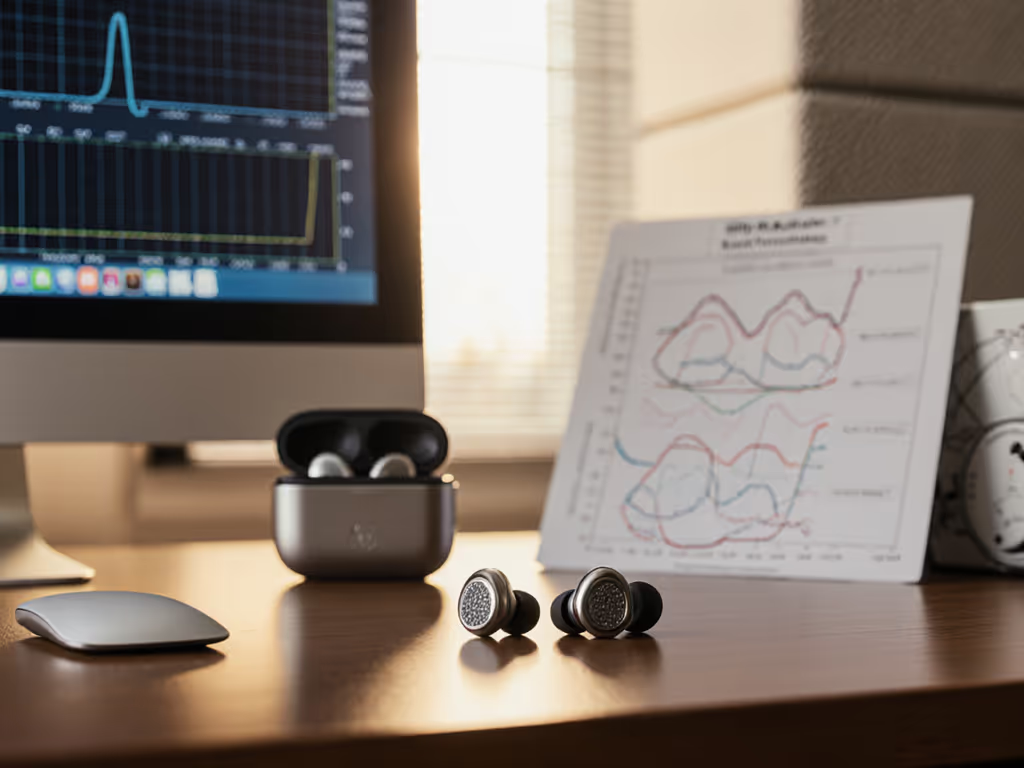
When you have audiophile earbuds for hearing loss, the conversation around sound quality shifts from pure frequency response metrics to a more grounded question: what actually reaches your ears, and in what proportion? High-fidelity listening with hearing challenges demands a different framework than standard reviews offer. The gap is not filled by driver specs or boutique DACs; it is written first by seal integrity, then by deliberate EQ compensation. This comparative analysis walks through how fit mechanics determine perceived tuning, why seal quality is the hidden variable nobody talks about, and how to layer EQ intelligently after you've locked down a stable, predictable acoustic foundation.
The Seal-First Principle: Why Fit Writes the Frequency Plot
In a studio quiet as snowfall, I once swapped tips on a reference monitor earbud and watched the measured response curve smooth where a poor seal had carved deep nulls around 5-7 kHz and again near 12 kHz. The driver hadn't changed. The EQ hadn't moved. Only the fit depth and seal quality shifted, and suddenly the frequency plot looked like someone had finally turned the lights on. That visual moment crystallized what I'd always suspected from listening: you cannot EQ what isn't reaching your ears consistently.
For anyone with high-fidelity earbuds for hearing impaired use, this principle becomes foundational. Hearing loss often clusters at specific frequencies: high-frequency roll-off is common, but so is a dip around 4 kHz or a trough in the mid-highs. If your seal is unstable or asymmetric (which it often is with asymmetric ears), you're fighting two problems: the hearing profile and an erratic acoustic path. The earbud shells might promise a flat tuning, but a loose seal creates venting that bleeds bass, thins mids, and lets treble scatter. You're not hearing the tuning the designer intended. You're hearing a broken promise.
The comparison here is stark. A properly sealed earbud with moderate EQ compensation will sound more intelligible and detailed than an unsealed earbud with aggressive EQ stacked on top. The seal comes first. For a deeper look at why seal alters measurements, see our seal impact on audio testing.
Seal Depth and Frequency Response: The Mechanical Reality
Ear-tip geometry directly shapes the acoustic cavity inside your ear canal, and that cavity length modulates how pressure waves interact with your eardrum. A shallow fit (where the tip sits near the canal entrance) creates a longer air column between the nozzle and your eardrum. That longer column amplifies resonances around 5-7 kHz, creating a peak that many users perceive as brightness or harshness. It also reduces bass coupling because the pressure building zone is further away.
Conversely, a deeper fit shortens that column, smoothing the 5-7 kHz bump and tightening bass response. For someone with hearing loss in the high midrange, a deeper fit might actually reduce the frequency imbalance your hearing profile requires. The alternative, compensating for that canal-resonance peak with heavy EQ cuts in the 5-7 kHz band, often results in a murky, indistinct sound because you're fighting both your hearing and the acoustics.
Asymmetric ears complicate this further. One ear might seal deeply with a small tip, while the other prefers a wider, shallower approach. Generic earbuds with single-size nozzles can't adapt. Minimal looks, maximal clarity requires that the hardware itself offer multiple pathways to fit stability.
Nozzle Angle and Shell Geometry
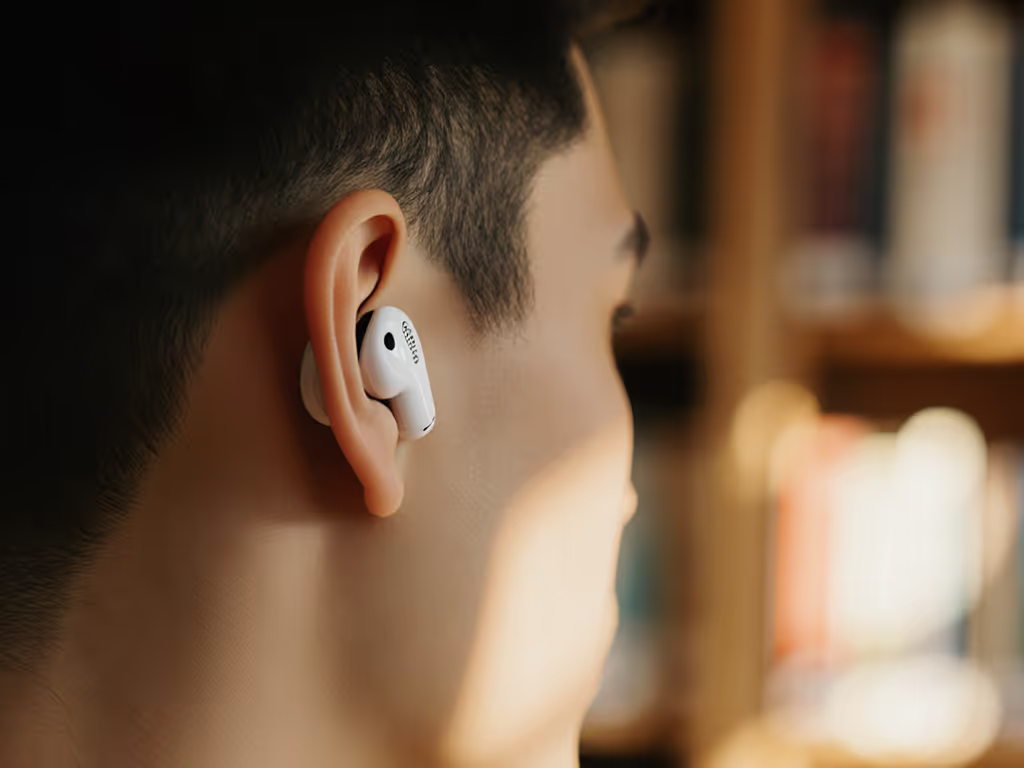
Two underappreciated variables: nozzle angle and where the shell actually contacts your ear. A nozzle angled slightly forward versus straight can shift how far the tip travels into your canal without changing tip size. Some shells are round; others taper to a narrower point at the nozzle or bulge wider in the middle for added stability. That geometry, combined with your ear-canal shape, determines whether the earbud rotates under pressure or sits locked in place.
Rotation is the silent killer of consistent tuning. If a bud rotates even 5-10 degrees during a workout or commute, the seal breaks intermittently. Bass drops, treble pokes through, and intelligibility suffers (especially critical when you're relying on compressed audio and EQ compensation to work through a hearing loss).
Tuning Strategies for Hearing Loss: When Seal Is Locked
Once your seal is predictable and repeatable (once fit writes the frequency plot and you know what you are actually hearing), then EQ and frequency compensation earbuds become tools that matter.
The comparison between off-the-shelf tuning and customized audiophile EQ customization hinges on whether your hearing profile is uniform or jagged. Mild, gradual high-frequency roll-off can often be addressed with a gentle shelving EQ above 2 kHz (a slope rather than a peak). This mimics how a hearing aid's prescription rises gradually. But if your hearing profile shows a sharp notch at 4 kHz (a common dip in age-related loss), a simple high-shelf won't help. You need a narrow-Q peak centered at 4 kHz to lift only that zone.
Standard tuning curves assume "normal" hearing. Even "warm" or "bright" tuning presets skip this personalization. A hearing profile audio tuning approach, by contrast, samples your specific loss across octave bands and builds compensation directly into the signal chain (either via EQ or via a parametric app that lets you dial in boosts where your ears need them).
Comparative Framework: Off-the-Shelf vs. Customized Approaches
| Approach | Pros | Cons | Best For |
|---|---|---|---|
| Preset tuning (flat/warm/bright) | Simple, no learning curve; consistent across genres | Ignores individual hearing profiles; can't adapt to asymmetric loss | Mild, uniform high-frequency roll-off |
| Manual EQ via app | Granular control; adapts to your specific loss profile; can adjust per-app | Requires effort upfront; easy to over-compensate; apps may drain battery | Moderate to complex hearing profiles; users willing to experiment |
| Audiologist-prescribed profile | Scientifically grounded; matched to hearing test; professional oversight | Expensive; requires multiple visits; limited to earbuds that support custom profiles | Significant or sudden hearing loss; multiple frequency notches |
| Hybrid: seal-locked + moderate boost | Fast to implement; respects seal mechanics; avoids over-correction | May not fully address jagged hearing profiles | Most users: establishes stable foundation, then refines |
The hybrid approach (prioritizing seal stability, then adding moderate EQ compensation) is where most listeners find the "maximal clarity" threshold. Heavy EQ amplification on an unstable seal is counterproductive. Light EQ on a locked seal compounds benefit.
Music Listening and Hearing Loss: Practical Considerations
Music listening hearing loss introduces a specific tension. Compressed formats (MP3, AAC, Spotify) already lose high-frequency detail, especially above 12 kHz. If you're compensating for hearing loss with aggressive treble boost, you're often amplifying silence (the compression artifacts that represent information that was never encoded). This leads to fatigue and poor intelligibility, not improved clarity.
The better approach: start with lossless or high-bitrate sources (FLAC, aptX and LDAC over Bluetooth if your earbuds support it), lock your seal, and apply modest EQ peaks only where your hearing test shows actual loss. For most hearing profiles with high-frequency roll-off, this means a gentle lift starting around 2-3 kHz, peaking somewhere between 3-6 kHz, then a second gentle lift above 8 kHz. This mirrors how hearing aid prescriptions are built (you're not hammering treble; you're restoring the balance your ears need).
Isolation matters, too. Effective noise isolation or ANC lets you listen at lower absolute volumes, which reduces ear fatigue and hearing damage risk during long sessions. For a deeper dive, see our ANC technology explainer. A sealed earbud with good ANC can deliver the same perceived clarity at 75 dB as an unsealed earbud at 85 dB. That 10 dB difference is meaningful over hours.
Fit-First Measurement: How to Know Your Seal Is Working
You don't need a measurement rig to sense whether your seal is locked. A few checks:
- Occlusion effect: Hum while wearing the buds. If the seal is deep and complete, you'll hear a low rumble in your head - that's normal. If the occlusion is uncomfortable, try a shallower tip or wider geometry to reduce it.
- Bass response: Play a bass-heavy track (around 60–80 Hz). If the bass feels present and even across both ears, seal is good. If one side feels thin or boomy, your seal is inconsistent.
- Silence isolation: Pause music and listen to ambient noise. Good isolation should drop ambient levels by at least 15-20 dB. If you hear wind or traffic clearly, your seal is venting.
- Stability under motion: Walk, jog, or move your head. If the sound doesn't waver or thin out, seal is holding. If treble or bass flutters, rotation is happening.
These are qualitative checks, but they're reliable. Once these pass, EQ becomes a refinement, not a rescue.
Building Your Personal Tuning
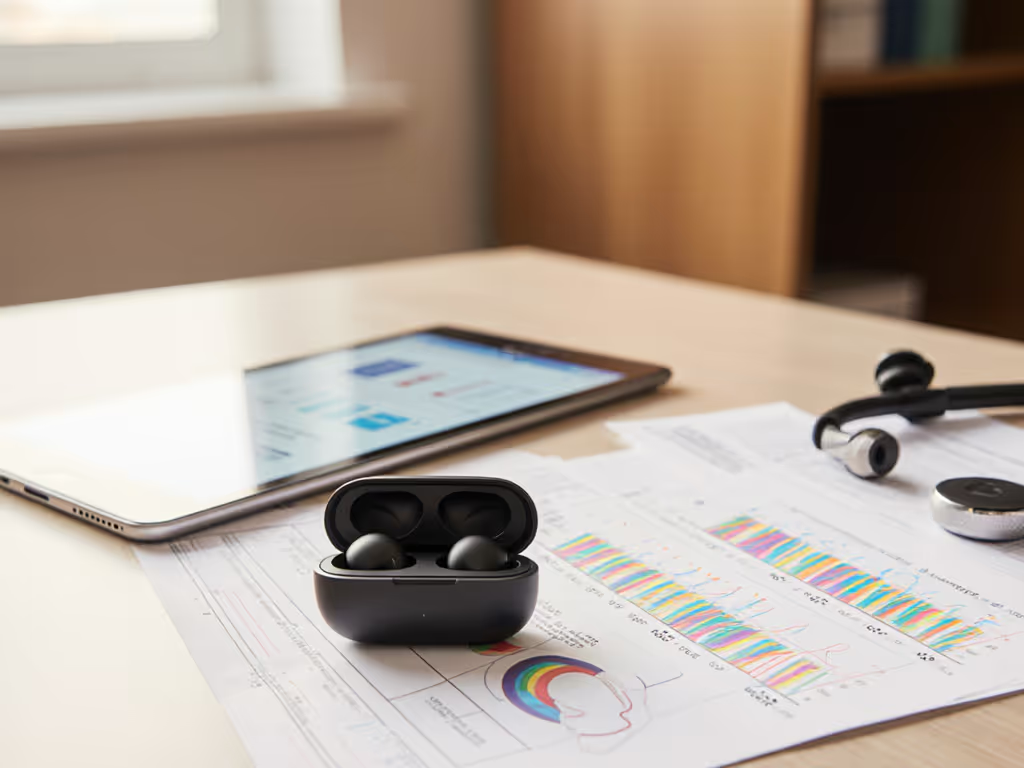
If you have access to your audiogram (your hearing test results), you have a starting point. Most audiograms show loss in dB across frequencies: 500 Hz, 1 kHz, 2 kHz, 4 kHz, 8 kHz, and sometimes 12 kHz. The gap between your threshold and 0 dB (normal hearing) is the loss you need to compensate for.
A simple rule of thumb: for every 10 dB of loss at a given frequency, boost that band by roughly 3-5 dB in your EQ, depending on bandwidth. If you show 20 dB loss at 4 kHz, a narrow-Q peak centered at 4 kHz, boosted by 6-8 dB, is a reasonable starting point. Then listen critically: does speech sound clearer? Does music sound natural, or fatiguing? Adjust in 1-2 dB steps and give each setting 30 minutes of real-world use before deciding.
Asymmetric hearing is common. If your left ear has more high-frequency loss than your right, some earbuds with per-channel EQ apps let you tune left and right independently. That granularity is rare in consumer products, but worth seeking out if your hearing profile is uneven.
Minimal Looks, Maximal Clarity in Practice
The most useful earbuds for hearing loss aren't necessarily the loudest or the most feature-rich. They're the ones that disappear into routine. A lightweight design that doesn't rotate, a seal that holds through a 6-hour workday, and EQ controls accessible without digging into a buried app menu (these quiet features matter more than ported shells or active drivers).
When seal is stable and EQ is patient, you stop thinking about fit and start hearing music. That's when the hearing loss becomes a constraint your tools have successfully adapted to, not a barrier dominating every listening session.
Moving Forward: Testing Your Fit and Tuning
The next step is diagnostic. If you haven't already, get a formal audiogram (many insurers cover baseline hearing tests, and independent audiology clinics often offer affordable screening). Armed with your actual loss profile, you can approach EQ with data, not guesswork.
Then, prioritize seal over any other feature. Test multiple tip sizes, nozzle lengths, and shell fits until you find the combination that holds rock-solid through motion, doesn't cause pressure pain after 30 minutes, and delivers bass and treble without thinning or harshness. Only then layer in EQ. You're not chasing a perfect frequency response curve (you're building a stable acoustic foundation and tuning for your ears, not the datasheet).
Explore whether your earbuds support parametric EQ (per-frequency band control) or just presets. Our companion app comparison shows which brands offer robust EQ, per-ear tuning, and hearing test features. If they support it, grab a hearing-test app or log your audiogram, and begin testing compensation curves. Start conservatively: undershooting always beats over-correcting. Let your ears and your routine guide refinement over weeks, not days. The goal isn't to sound like someone with normal hearing; it's to hear music and speech with clarity and comfort specific to your hearing profile and the way you move through your day.
Related Articles