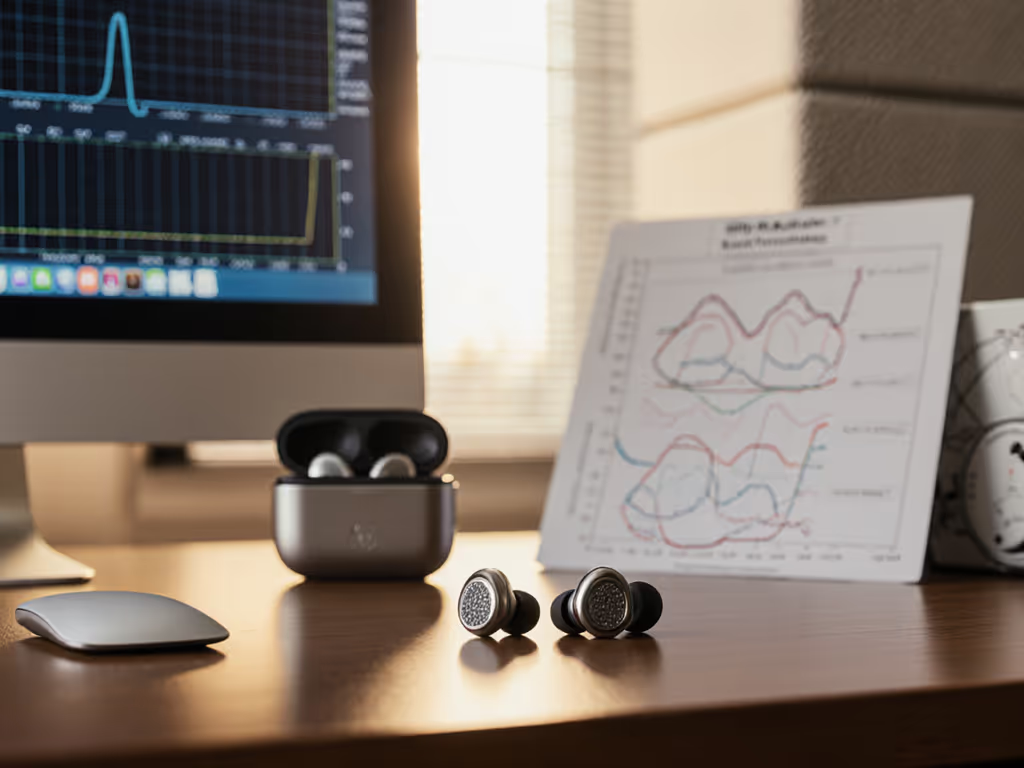
Hearing Loss Profile Earbuds: Find Your Perfect Fit
By Tomoko Sato • 15th Mar
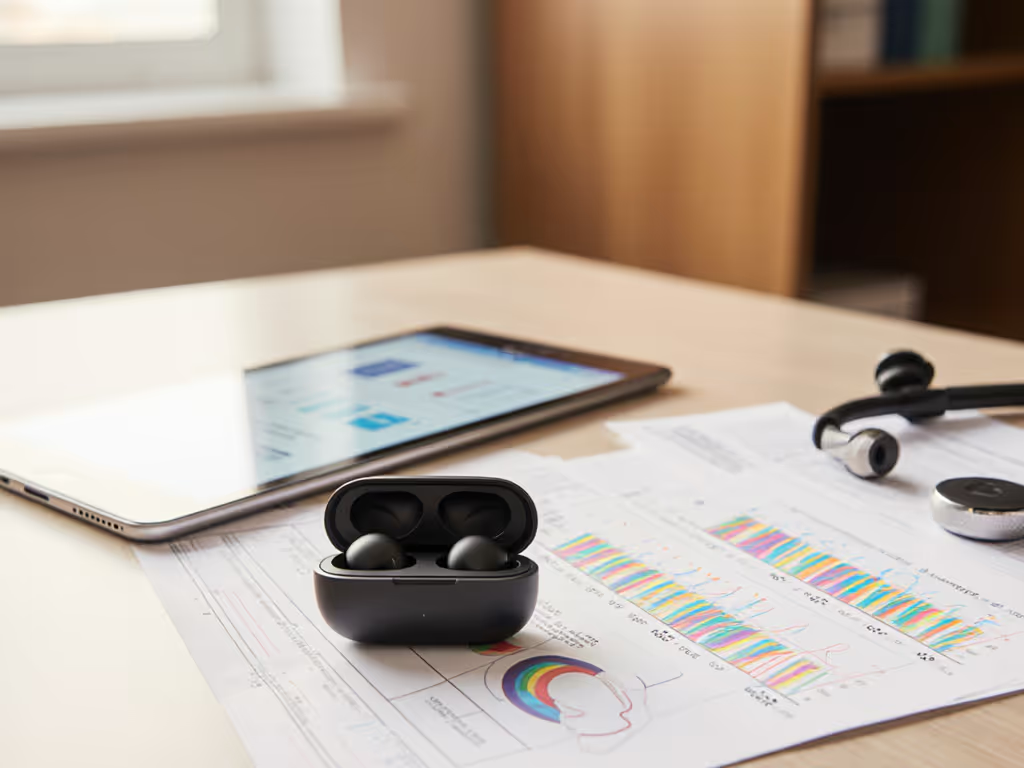
Hearing loss profile earbuds and customizable hearing earbuds have transformed how people with hearing challenges experience audio, and they've done it without sacrificing comfort or style. Whether you're navigating mild hearing loss, managing moderate challenges, or seeking frequency-specific earbud tuning, the right fit matters far more than specs alone. Let me walk you through the questions that matter most, and how to cut through the noise.
Why Fit Matters More Than You Think
One bleary morning before a critical client demo, my Bluetooth earbuds refused to switch from my laptop to my phone. I stood juggling settings and coffee, frustrated and late. That fiasco wasn't about features. It was about what wasn't working, and it made me realize something deeper: if device switching isn't seamless, the features might as well not exist. The same principle applies to hearing loss profile earbuds.
When fit is unstable, seal is inconsistent, or pressure builds in your ear canal, every other advantage (AI noise reduction, premium sound processing, multipoint connectivity) crumbles. See how earbud fit impacts hearing health for the science behind seal, insertion depth, and ear pressure. A poorly fitting earbud that shifts during a call, creates occlusion pressure after an hour, or sits too proud against your ear will land in a drawer, features unused.
Your ear is unique. Your routine is unique. Your hearing profile is unique. Mass-market earbuds ignore this. Customizable hearing earbuds are built on the opposite premise: fit first, performance follows.
What Is a Hearing Loss Profile Earbud?
Q: How is a hearing-aid earbud different from a standard wireless earbud?
Hearing-aid earbuds are engineered for people with hearing loss: specifically, they compress and amplify audio in frequency ranges where your hearing is compromised. Standard wireless earbuds assume normal hearing and are tuned for enjoyment; they boost bass and treble for flavor, not compensation.
A hearing loss profile earbud typically includes:
- Personalized amplification mapped to your audiogram (your unique hearing curve)
- Feedback suppression to eliminate the whistling that plagued older aids
- Directional microphones to help you follow conversation in noisy spaces
- Telehealth or self-fit pathways so you're not tethered to an office appointment
- All-day battery and compact form so they live in your ear, not a drawer
Q: Are they really earbuds, or are they hearing aids masquerading as earbuds?
Both. The best options blur the line intentionally. Models like the Signia Active Pro IX are purpose-built hearing aids that happen to look like earbuds and include dust/sweat protection (IP68 rating) for active lifestyles. Others, like Eargo Link, prioritize all-day comfort and speech clarity while staying invisible in your ear.
The key difference from cosmetic "earbuds that boost volume": proper hearing-aid earbuds include FDA-validated algorithms, professional fitting (or validated self-fit apps), and sound processing tailored to your specific hearing loss, not just louder volume.
Comparing by Hearing Loss Severity
Q: Which profile earbud matches my hearing loss level?
This is where research data helps. Here's the honest map:
Mild Hearing Loss
If your audiogram shows hearing thresholds between 20-40 dB across most frequencies, mild hearing loss earbuds are your lane. These over-the-counter (OTC) options require less processing power and fit a broader range of ear shapes:
- Elehear Beyond: Connects via standard Bluetooth (like pairing regular headphones), offers app-based sound adjustments, and delivers up to 20 hours of total battery life from its case. Noise reduction effectively separates speech from background sounds, and because it avoids accessibility-layer complexity, it is less intimidating for newcomers.
- Eargo (specific models): Tiny, entirely in-canal design prevents the "plugged ear" sensation that makes some people abandon hearing aids. The trade-off: self-fitting requires patience and troubleshooting via app.
All-day comfort checklist for mild loss:
- Start with the smallest tip size and work up only if seal is weak
- Test in quiet first, then progressively noisier environments
- Wear for 1-2 hour sessions before committing to 8-hour days (your brain adapts, but it takes time)
Moderate Hearing Loss
Thresholds between 40-70 dB? You're in the sweet spot for modern hearing-aid earbuds. This is where moderate hearing loss audio options flourish because processing demands are real but not extreme, and most ear shapes can accommodate mid-sized shells.
Jabra Enhance Plus is often rated best overall OTC for this range due to sound quality, battery longevity, customization via app, and Bluetooth stability for calls. The form factor (compact, stable) resists rotation during motion, critical for call clarity.
Signia Active Pro IX bridges professional-grade fitting and active-lifestyle durability. Internal Conversation Enhancement isolates speech, IP68 waterproofing handles sweat, and recharging is seamless for on-the-go professionals.
Moderate loss fit strategy:
- Seal is everything. Weak seal = weak bass and unstable ANC. If ANC feels inconsistent, learn how active noise cancellation works and why fit changes its effectiveness.
- If one ear seals and the other drifts, test asymmetric tip sizing (small on one side, medium on the other) (this is normal, not a defect).
- Budget 1-2 weeks for your brain to stop perceiving your own voice as too loud (Own Voice Processing reduces this, but adjustment takes time).
Severe Hearing Loss
Thresholds above 70 dB or steeply sloping losses (good low-frequency hearing, poor high-frequency) demand prescription devices and professional fitting. OTC options may fall short because they lack the power and custom earmold precision you need.
Signia Pure Charge&Go (prescription) and Phonak Sphere Infinio (prescription, flagship from the world's top manufacturer) are designed for this range. Both use Split Processing and AI to isolate speech, reduce background noise, and maintain clarity across severe losses. Phonak Infinio's dual-chip architecture powers real-time adjustments in dynamic environments, and the difference is tangible in busy restaurants or open offices.
Custom earmolds are often recommended for severe loss to provide superior comfort, improved sound quality, and reduced feedback.
Severe hearing loss requires professional fitting, not DIY self-fit.
Frequency-Specific Earbud Tuning: What You're Actually Buying
Q: What does "frequency-specific" mean, and do I need it?
Your hearing loss isn't flat. You might hear 250 Hz (low bass) just fine but struggle at 4,000 Hz (upper mids, where much speech clarity lives). Frequency-specific earbud tuning means the earbud amplifies selectively (boosting only the frequencies you've lost, while leaving your good hearing untouched).
This is why a generic "volume-up" earbud fails:
- It makes everything louder, including frequencies you hear well, causing fatigue and feedback.
- It doesn't target the specific gaps in your hearing profile.
Proper hearing-aid earbuds:
- Capture your audiogram (via professional test or validated self-fit app)
- Map amplification to those precise frequencies
- Apply noise reduction that preserves speech cues, not just noise suppression
Elehear Beyond's noise reduction effectively separates speech from background sound, demonstrating this principle for mild-moderate losses. Signia's Split Processing does the same for severe losses. While you fine-tune amplification, follow safe listening guidelines to protect your hearing.
Simple wins daily: Frequency-specific tuning sounds complex, but from your end, it's invisible. You just hear better in real situations. That's the goal.
The Fit and Comfort Equation
Q: I've had bad experiences with standard earbuds, loose, painful, or protrude against my hat. Will hearing-aid earbuds be different?
Yes, if you choose the right model and prioritize fit first. Here's why:
Most hearing-aid earbuds are optimized for 8-hour all-day wear (a clinical requirement). Loose fits and pressure pain are deal-breakers for long-term use, so manufacturers engineer for stability and ergonomic shell geometry. Standard consumer earbuds are often designed for 1-2 hour sessions.
Widex Allure ITE R D, for example, is a completely-in-canal (CIC) design tailored to your ear shape with sound directionality to help separate speech from noise. The custom fitting process ensures it maps precisely to your ear geometry, eliminating the asymmetric-ear frustration (one side sealing, the other drifting).
Signia Active Pro IX's sleek form and IP68 rating make it suitable for active users, but equally critical: the internal geometry favors shallow insertion for people who can't tolerate deep canal placement.
Fit and comfort checklist:
- Tip material matters: Silicone, foam, hybrid. If you've had irritation or itchiness before, ask what the device uses and whether swappable options exist.
- Shallow vs. deep insertion: Know your preference before buying. Some ears dislike deep-seated earbuds; others need depth for seal. Retailers should clarify this.
- Shell width and height: Asymmetric ears need symmetry-agnostic design or multiple shell sizes. Ask before committing.
- Weight and center of mass: Heavy buds rotate during motion and fatigue the tragus (that little cartilage bump). Lighter is safer for all-day wear.
- Pressure and occlusion: ANC can trap air and create a "plugged ear" sensation. Advanced Own Voice Processing (found in Signia models) reduces this discomfort.
Navigating Self-Fit vs. Professional Fitting
Q: Do I need an audiologist appointment, or can I self-fit at home?
Both paths work. Choose based on your confidence and hearing loss severity.
Professional Fitting (Prescription Path):
- Best for moderate-severe losses
- Audiologist performs real-time frequency-response testing and custom earmold fitting
- Remote follow-ups available (e.g., Signia's app allows remote adjustments post-fitting)
- Higher cost ($2,000–$5,000+), but insurance may cover it
Self-Fit (OTC Path):
- Appropriate for mild-moderate losses
- You complete a validated hearing test via app or web (often free or $30–$50)
- Earbud software adapts based on your responses
- Remote support available with some brands (e.g., Eargo offers remote support despite being self-fit)
- Lower cost ($300–$1,500), faster to start
- Requires some tech comfort and patience tuning via app
Self-fit reality check:
- Validated audiometric apps (using your phone's mic) are surprisingly accurate for mild-moderate losses.
- Fine-tuning takes 1-2 weeks; don't assume "wrong" on day one.
- If you're not seeing improvement after 3 weeks, consult a professional.
Actionable next step: Identify your hearing loss severity first. Free online hearing tests (conducted responsibly, with headphones in a quiet room) can narrow this down. If the results suggest mild-moderate loss and you're tech-comfortable, OTC self-fit is a safe, cost-effective entry point. If you're severe, over 60, or uncertain, book a professional audiogram. The $50 test now saves confusion and returns later.
Battery Life and Real-World Durability
Q: Will I be charging these constantly? What about durability in sweat and weather?
Modern hearing-aid earbuds charge overnight and deliver 16-20 hours of use per charge, with cases extending that to several days. For a realistic view of wireless earbud battery life, see our breakdown of real vs advertised endurance. Much depends on ANC use and streaming; voice-only mode stretches battery further.
Durability under sweat and weather:
- IP68 rating (like Signia Active Pro IX) means fully dust and sweat proof, surviving submersion up to 1.5 meters. Safe for HIIT, running, cycling.
- IP52 rating (like Jabra Enhance Plus) means splash-proof; fine for sweat and light rain, but not chlorine or full submersion.
- No IP rating means dry-use only; avoid sweat-heavy workouts and rain.
Earwax and moisture management:
- Hearing-aid earbuds accumulate earwax faster than standard earbuds because fit is tighter.
- Most include cleaning tools; use them weekly.
- Foam tips degrade faster under sweat; budget replacements every 3-4 months.
- Silicone tips last longer but may slip under humidity.
Simple wins daily: Buy a replacement tip kit upfront. They're $20–$40 and eliminate the "my buds stopped sealing" panic that actually means your tips wore out.
Multipoint and Call Quality
Q: Will these handle my work calls and gym playlist switching without drama?
Multipoint (pairing to laptop and phone simultaneously, switching based on which device has active audio) is now standard on quality hearing-aid earbuds. Phonak Sphere Infinio boasts "best-in-class Bluetooth connection" with 2x the range, compatible with both Android and iPhone. Jabra Enhance Plus and most recent Signia models support multipoint.
Call quality depends on fit stability:
- Unstable fit → mic captures environmental noise, people complain of wind or rustling.
- Stable fit → directional mics focus on your voice, suppressing room noise.
- This is why fit comes first. Multipoint features are wasted if mic quality is compromised.
Call quality checklist:
- Test a call on your first day. If the other person complains of background noise, reseat your buds.
- Use the app to confirm mic settings if available.
- If it doesn't improve after 3 resets, the issue is likely fit, not the device.
Putting It All Together: Your Decision Tree
Start here:
- Identify your hearing loss severity: Free online test or $50 professional screening.
- Know your lifestyle: Desk work (professional fit may be overkill), active/sweaty (IP-rated mandatory), or hybrid.
- Pick your pathway: Professional prescription (peace of mind, custom earmolds), or OTC self-fit (faster, cheaper, works for mild-moderate).
- Prioritize fit: Tip material, insertion depth, shell size, and weight matter as much as sound processing.
- Start small: Buy or trial from a retailer with a return window (30 days minimum). Test in real environments, not just quiet rooms.
- Give your brain time: Hearing aid adjustment is 2-4 weeks, not 2-4 days.
Final Word
Hearing loss profile earbuds exist because one-size-fits-all audio ignores your unique hearing, ear shape, and daily routine. The best fit eliminates the friction: no reseating, no pain, no compromised calls or ANC. That invisibility (where the earbud just works) is the entire point.
Your next step: Take a free hearing screening, list your pain points (fit instability, ear pain, asymmetric sealing, whatever applies), and match them to the profile earbud category above. Then trial a model with a forgiving return policy. Discomfort on day one doesn't mean failure; adjustment takes time. But discomfort on day 14 signals a fit problem, and that's solvable with tip changes or professional refitting.
Simple wins daily. Start with fit, let everything else follow.
Related Articles