Wireless Translation Earbuds That Actually Fit Long Flights
By Kwesi Mensah • 10th May

Introduction
You're six hours into a cross-Atlantic flight, and your earbuds have been translating a podcast for the last two hours, but you've already readjusted them four times. The seal on your left side keeps breaking. Your right ear aches. The audio cuts out when you lean against the window. Sound familiar?
The promise of wireless translation earbuds is tantalizing: real-time language bridging, seamless calls across borders, and a sleek device that fits in your pocket. But the real test isn't in the marketing specs or the promise of "all-day comfort." It's whether they'll actually stay put, seal properly, and survive the rigors of travel without leaving you reaching for your wallet every six months to replace dead batteries or lost buds.
Wireless translation earbuds come in many flavors, from premium multi-language systems to budget-friendly models that claim to do everything. The problem: most reviewers ignore what actually matters on a long flight. They skip over fit geometry, tip durability, warranty depth, and real battery endurance. I've seen travelers spend hundreds on buds, get frustrated after a two-week trip, and end up with a drawer full of dead inventory.
I learned this lesson the hard way years ago, helping a college radio station manage a crisis. We had a drawer of budget earbuds purchased on sale (dozens of them), all dead within months. We tore them down, weighed the batteries, analyzed tip material degradation, and spreadsheet-mapped the failures. The pattern was stark: these weren't cheaper because they were simpler; they were cheaper because they were built to fail. The lesson stuck with me: value is durable fit, not a coupon in disguise.
This article flips the typical review on its head. Instead of listing specs, I'm presenting a numbered evaluation framework. Before you buy wireless translation earbuds, especially for travel, run them through this checklist. You'll spend less money, waste less electronics, and actually enjoy your flights. For travel-focused picks and comfort strategies, see our long flight earbuds comfort guide.
The Evaluation Framework
1. Fit Reliability Score Over Raw Specs
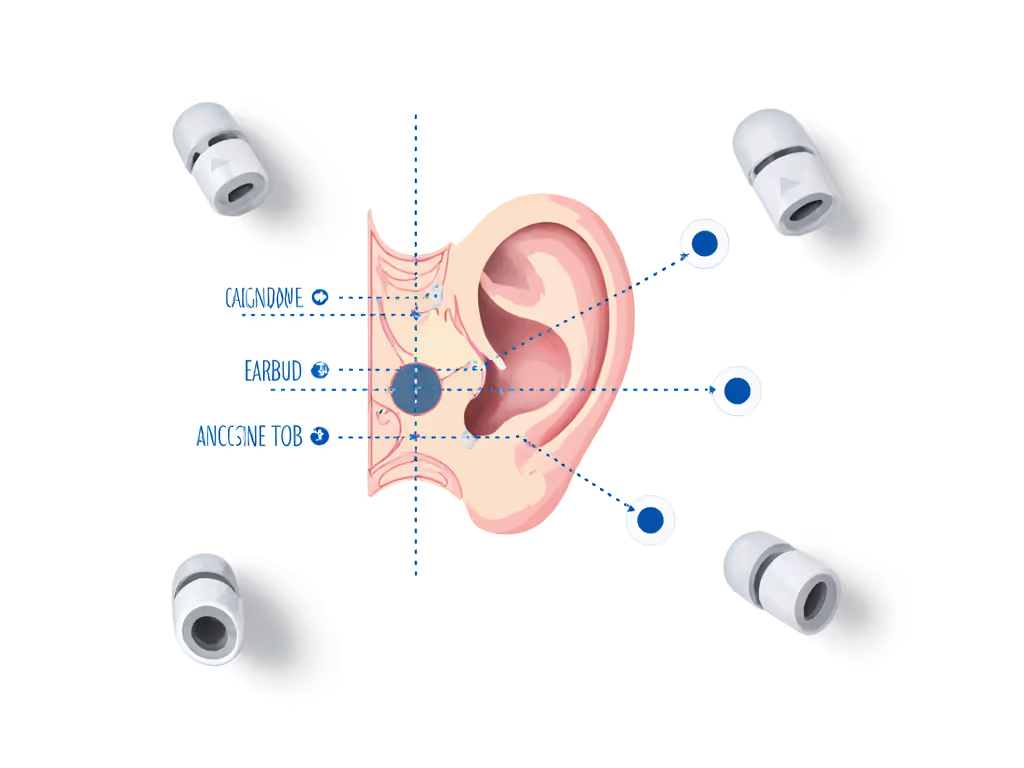
Every manufacturer claims their earbuds "conform to your ear shape." That's marketing language. What you need is specific, measurable fit data: nozzle angle, shell width and height, insertion depth, and center of mass. Real fit reliability comes from convergent design: shells that match common ear geometries without hot spots, and tips that seal consistently without pinching.
Before any earbud reaches your ears, ask the maker for:
- Shell dimensions (width × height, insertion length)
- Nozzle angle relative to the stem (critical for ear-canal alignment)
- Weight per bud (uneven weight causes rotation during movement)
- Tip geometry options (shallow vs. deep insertion, stem flexibility)
Compare these numbers across models. A 5.8 mm shell width that balances properly in a medium-sized ear canal will outperform a 6.2 mm shell with a low center of mass on a long flight. If you want model-by-model ergonomics, start with our comfort fit comparison. Fit reliability scores. Specs don't.
2. Tip Ecosystem and Customization Options
The pit of buying earbuds is discovering that the tiny tips included in the box don't work for your ear, and the maker doesn't sell spares (or charges $30 for a set). For travel language assistance and extended wear, tip flexibility is non-negotiable.
Evaluate the ecosystem:
- Silicone and foam options in multiple sizes (XS through L, not just S/M/L)
- Hybrid tips (soft outer ring with firm inner bore for seal without pressure)
- Wing or fin attachments for stability during workouts or sleep on aircraft
- Easy, documented compatibility (no mystery whether third-party tips fit)
- Availability (are spares in stock, or do you wait six weeks?)
- Price per replacement set (below $15 signals customer-first design; $30+ suggests planned obsolescence)
This is where depreciation-aware thinking kicks in. A $150 earbud with a robust tip ecosystem will outlast a $100 model with a one-size-or-nothing approach. You'll replace tips, not buds. Waste less, fit better.
3. Warranty, Support, and Replaceable Parts Availability
Comfort is only durable if the earbud ecosystem supports it. On a two-week international travel communication journey, you don't have time for cross-border warranty disputes.
Red flags:
- Warranties under 12 months
- No coverage for fit-related returns (if an earbud doesn't seal after two weeks, you should be able to return it)
- No way to order spare tips or replacement earpieces directly from the maker
- Support channels that don't include local phone or live chat
Green flags:
- 24-month warranty as standard
- No-questions-fit guarantee (30-day trial period)
- Clear parts catalog with documented compatibility
- Support teams that acknowledge regional differences (different ear shapes across populations; one-size-fits-all is a risk flag)
4. Battery Longevity and Real-World Flight Duration
"Up to 8 hours" on a single charge is meaningless. Real flight scenarios demand transparency: battery life at actual usage patterns (calls, translation activation, ANC on, streaming).
Cost-math principle: A model with 6-hour real battery life and a case that holds 18 additional hours costs you less over two years than an 8-hour model with a weak case that dies within 18 months.
Ask for:
- Real-world battery tests (streaming audio, ANC on, variable volume)
- Case capacity (does it actually deliver the promised "all-day" runtime?)
- Battery replacement cost if cells degrade (is it $30 or $120?)
- Degradation rate (what's battery health after 500 charge cycles?)
A maker that doesn't publish this data is banking on your upgrade cycle, not your loyalty. We break down real vs advertised battery life and the factors that actually drain earbuds in-flight.
5. Seal Consistency and Audio Performance
A broken seal ruins multi-language earbuds. If the fit shifts mid-flight, latency spikes, background noise leaks in, and your translation becomes unreliable. Pressure build-up from poor seal design also causes ear fatigue, and on a long flight, that's disqualifying. For when to enable passthrough on planes and how brands implement it, read transparency mode explained.
Test for:
- Stability during head movement (lie on a pillow, rotate your head; do the buds loosen?)
- Seal recovery after reinsertion (if you take them out and replace them, does the seal re-establish immediately?)
- Pressure release (can you open your mouth without air pressure spiking?)
- Shell contact with tragus/anti-tragus (sharp contact points are pain seeds)
Transparency mode (if included) should reproduce ambient sound without hollow, "inside a cave" artifacts, a sign of poor seal design.
6. Weight and Shell Design for Flight Comfort
Earbuds that protrude or touch your ears' bony structures will hurt after 45 minutes. Low-profile shells are non-negotiable for sleep on aircraft.
Measure:
- Overall earbud weight (under 5 grams per bud is preferred; over 7 grams causes rotation and pressure)
- Protrusion depth (does it stick out more than 8mm from the canal? High risk for pillow contact)
- Shell curvature (rounded profiles reduce contact pressure vs. angular designs)
A heavier bud with better weight distribution beats a light bud with poor balance. Center of mass matters more than weight.
7. Durability Under Sweat, Humidity, and Extended Use
International travel means humidity, temperature swings, and irregular cleaning. Budget earbuds fail catastrophically in these conditions.
Non-negotiables:
- IP rating of at least IPX4 (splash resistance; IPX5+ if you anticipate sweat)
- Non-porous shell materials (ceramic composite or sealed plastic; avoid paint finishes that flake)
- Silicone gasket quality (prevents humidity ingress into battery compartments)
- Nano-coating on driver (not mandatory, but signals engineering rigor)
- Documented cleaning protocol (not just "wipe down"; include drying guidance)
A maker that publishes a durability tear-down (components, materials, pressure testing) is signaling confidence. Most won't.
8. Total Cost of Ownership (Depreciation and Support)
The sticker price is not the full picture. Calculate:
- Replacement tip cost × expected useful life (do they last 6 months or 18 months?)
- Warranty coverage vs. likely failure modes (what breaks, and are you covered?)
- Support costs (return shipping, replacement lead times)
- Battery replacement (if needed within 2-3 years)
- Resale value (some models hold 30-40% of original price; others, 5%)
A $200 earbud with replaceable parts, a two-year warranty, and strong support infrastructure might cost $280 total over three years. A $100 model with limited tips, no warranty, and proprietary parts might cost $240 after one year, because you'll replace the entire pair. Spreadsheet it. Real value emerges.
9. Translation Latency and Call Quality
Translation earbuds live or die on latency. Dive deeper into how seal and processing shape results in our translation accuracy guide. If there's a perceptible delay between speaker and text-to-speech output, the experience breaks down. On a call, poor microphone stability (from a failing fit) murders call quality.
Evaluate:
- Published latency specifications (under 200 ms is noticeable; under 100 ms is ideal)
- Microphone design (are there multiple mics for noise cancellation? Does positioning matter?)
- Fit impact on mic performance (if seal breaks, wind noise and ANC fail; test this)
- Offline translation support (network latency vs. on-device processing; which is more reliable?)
Translation performance is directly correlated to fit stability. A $150 earbud with perfect seal will outperform a $300 model with a loose fit.
10. Risk Flags to Watch Before Buying
Before you commit, scan for these patterns:
- No third-party teardowns available (makers that don't allow disassembly are hiding something)
- Limited review data on long-term comfort (if only the first week is comfortable, that's a flag)
- Inconsistent sizing nomenclature (S/M/L vs. XS/S/M/L/XL; inconsistency suggests supply-chain shortcuts)
- No published support contact info (good luck troubleshooting mid-trip)
- High return rates mentioned in forums (Reddit, AVExchange, Crinacle; check what users report)
- Frequent firmware updates required for stability (sign of rushed hardware design)
- Vague warranty language ("normal wear and tear" exclusions are deal-killers)
One risk flag isn't disqualifying. Three or more is a signal to keep shopping.
Summary and Final Verdict
Wireless translation earbuds can unlock seamless travel communication, but only if they fit, stay put, and last beyond the first trip. The market is flooded with options that optimize for launch buzz over durability and real support.
Use this framework before buying:
- Demand fit data (shell dimensions, nozzle angle, center of mass).
- Verify tip ecosystem (multiple sizes, hybrid options, affordable spares).
- Check warranty depth (24 months minimum; fit-guarantee preferred).
- Calculate battery reality (real-world tests, case capacity, replacement cost).
- Test seal consistency (lie-down test, reinsertion, pressure release).
- Measure weight and profile (low-profile, under 5g per bud).
- Verify durability (IPX4+, non-porous materials, documented longevity).
- Do the math (total cost of ownership over three years).
- Assess translation performance (latency, microphone stability, fit dependence).
- Scan for risk flags (third-party data, support accessibility, return patterns).
Value is durable fit, not a coupon in disguise. A mid-range model engineered for stability, backed by solid support, with a real tip ecosystem, will serve you better than a premium model optimized for marketing.
Your ideal pair isn't the fanciest; it's the one that seals predictably, supports your ear geometry, and comes with a maker that actually stands behind the product. Test the framework, compare your shortlist against these ten criteria, and you'll waste less electronics and enjoy your flights more. The cheapest option rarely delivers the best value. Neither does the most expensive.
Waste less, fit better. That's the real translation.
Related Articles