Stage Performance Earbuds: Monitor & Fit Tested
By Kwesi Mensah • 2nd May
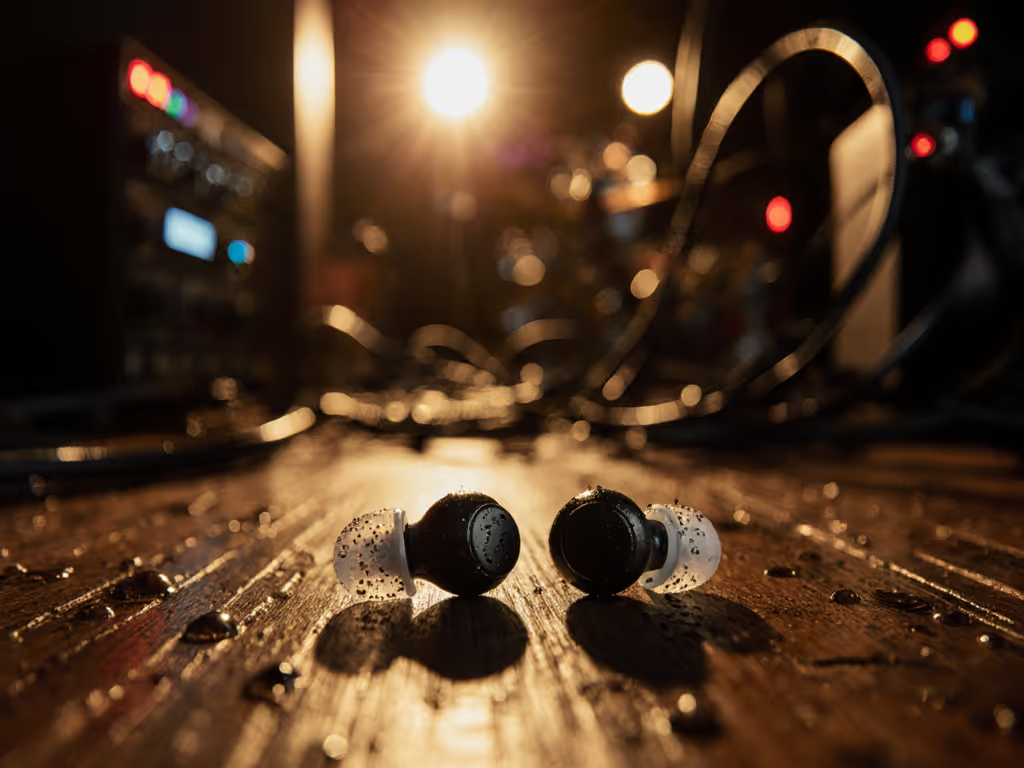
Studio monitor earbuds have become essential tools for live performers, but not all are built for the demands of the stage. Unlike consumer listening, stage performance earbuds must deliver low-latency audio feedback, maintain a secure fit through hours of movement, and endure sweat and environmental stress without compromising sound quality. What separates a genuine monitoring solution from a fitness earbud rebranded for pros is rarely what marketing highlights, it is often the overlooked details: tip geometry, nozzle angle, battery management under thermal load, and whether the manufacturer supports replacement parts a year after purchase.
I've watched too many musicians and audio techs return to the rental counter with earbuds bought on a weekend discount, only to discover they don't stay in their ears during a set or that the left channel cuts out after six months. Years ago, while helping a college radio station replace a drawer of dead buds they'd bulk-purchased on sale, we tore them down to understand why. We weighed the batteries, matched tip compatibility, and spreadsheeted the failure points. The pattern was clear: cheap doesn't mean small cost. It means cost deferred: to returns, to downtime, to frustration mid-performance. That lesson drives how I evaluate stage monitors today. Value is durable fit, not a coupon in disguise. And for stage work, durable fit means testing under load, under pressure, and across diverse ear anatomy.
This guide examines the core variables that determine whether latency-free earbuds for musicians actually deliver professional reliability, and provides a framework for auditing options against real performance needs. For model recommendations tuned for flat, stage-ready monitoring, see our professional musician earbuds guide.
1. Latency & Audio-Processing Architecture
Latency is non-negotiable in stage monitoring. A performer hearing their vocal or instrument 50-100 milliseconds delayed from their physical action will struggle to stay in time. Most true monitoring solutions use dedicated wireless protocols (Shure PSM, LD Systems, Roland) that manage latency at the system level, separate from consumer Bluetooth. If you're using consumer-grade earbuds, latency depends on: Understand how audio codecs impact latency and quality before you pick a pair.
- Codec choice: aptX Low Latency (~40 ms) and LDAC over aptX perform better than standard SBC (~100-150 ms). Verify which codecs the earbuds actually support under load; marketing lists often assume ideal conditions.
- Bluetooth chip and firmware: Qualcomm CSR and MediaTek chipsets vary in real-world latency. Ask the manufacturer for measured end-to-end latency, not theoretical specs.
- Mixer/transmitter pairing: Some entry-level mixers introduce additional buffer delay. Test with your exact signal chain.
Risk flag: If a vendor cannot provide third-party latency measurements or measured performance across their wireless stack, treat latency claims as unverified. Many casual earbuds claim "low latency" but measure it under cherry-picked conditions.
2. Fit Stability Under Prolonged Movement & Heat
A monitor earbud that stays perfectly sealed in a quiet office will shift the moment you're onstage under lights, sweating, and moving. Fit stability depends on three factors:
- Shell geometry & contact points: Examine the nozzle angle (forward/backward tilt), how the shell contacts the concha and anti-tragus, and whether there are stabilizing wings or fins. Small differences in nozzle angle (even 5-10 degrees) change how the earbud sits under jaw movement and heat.
- Tip selection & material: Silicone tips swell slightly when wet; foam tips compress and migrate. For stage use where sweat is constant, you need multiple tip geometries (shallow/deep insertion options, and ideally both silicone and foam). Verify the manufacturer stocks replacements and pricing, often overlooked until you need a backup mid-tour.
- Seal repeatability: The seal must hold during head movement, yawning, and heat-induced ear-canal expansion. Test fit by wearing during a short performance or high-intensity workout, not just standing still. If the fit drifts after 20 minutes, it will drift during a 90-minute set.
Risk flag: Marketing photos showing performers mid-jump with perfect earbuds don't tell you about seal loss under sustained perspiration or whether tips are available as replacements six months after purchase.
3. Audio Characteristics & Monitoring Workflows
Monitoring is not "hi-fi listening." A performer needs clarity on their own vocal or instrument, separation from backing tracks, and minimal coloration that would mask problems. Key specs to verify:
- Frequency response flatness: Request measured FR curves, not marketing adjectives. 20-20 kHz "Hi-Fi" earbuds often have boosted mids and presence peaks that muddy vocal detail in a live mix.
- Custom mix capability: Can you route independent mixes to left and right, or are both ears locked to the same mix? Professional systems offer stereo mix control; consumer adaptations often don't.
- Transparency or ambient mode: Some performers need to hear the audience, stage cues, or click. Verify the ambient feature doesn't compress ambient sound or introduce digital artifacts.
- ANC interaction with seal: Active noise cancellation changes character based on seal quality. Inconsistent fit = inconsistent ANC, which degrades monitoring consistency.
4. Battery Endurance & Thermal Management
Stage use often involves hours of continuous playback under heat (body temperature, stage lights, amp rack proximity). For the science behind uneven drain and capacity loss, read about earbud battery degradation. Battery specs alone are misleading:
- Real-world runtime under load: Battery capacity (mAh) and nominal voltage don't predict endurance when video processing, Bluetooth streaming, and ANC are active. Ask for measured runtime under simultaneous latency-critical + ANC + continuous playback conditions, not ideal-case marketing numbers.
- Thermal throttling risk: Lithium batteries lose capacity and self-discharge faster under heat. If a monitor earbud is rated for 8 hours at 20°C in a lab, you may see 5-6 hours on a summer stage. Plan battery cycles accordingly and test real-world endurance before a critical performance.
- Case charging speed & capacity: Can the case provide fast-charge to earbuds if you need a mid-set top-up? Standard cases often need 15-30 minutes; professional systems offer 5-10 minute top-ups. Verify if case capacity is sufficient for your performance length and number of sets.
5. Durability & Sealing Against Sweat/Moisture
Sweat is an earbud killer. Get clarity on IPX ratings to match protection to your stage conditions. Silicone seals degrade, internal corrosion starts, and connection points corrode. Longevity depends on:
- IPX rating verification: IPX4 handles light sweat; IPX5/7 is safer for heavy perspiration. But ratings don't guarantee internal protection. Request teardown data or warranty details for moisture-related failures. Some manufacturers exclude sweat damage from warranty despite marketing IPX ratings.
- Drainage design: Quality monitor earbuds include drain paths so sweat doesn't pool against components. Check if the design includes exhaust ports or wicking materials; if it's a closed cavity, seal failure becomes a pressure-cooker for corrosion.
- Tip material durability: Silicone tips can harden or crack after months of daily use; foam tips compress and eventually fail. Value survives year two. Confirm the manufacturer stocks replacement tips, price them transparently, and ensure they're easily swappable (not glued or soldered).
6. Support Ecosystem & Repair/Replacement Availability
This is where many performers discover hidden costs. See our earbud repairability comparison to gauge which models can actually be serviced over time. After a year, if one earbud fails, can you:
- Buy a single replacement earbud (not a full pair)? Some brands sell singles; others force you to replace both. Significant cost difference.
- Access replacement tips, ear-hooks, or stabilizers? Verify part numbers, availability, and lead times. If tips are backordered for 4 weeks, that's a problem if you have a tour.
- Get warranty service without proof of purchase? Serial number registration and straightforward RMA processes matter when you're traveling. Some vendors require original receipts or impose strict timelines.
- Find compatible third-party tips? Aftermarket tip ecosystems (e.g., Comply, SpinFit, Dekoni for IEM-style buds) expand your options. Native-only ecosystems limit flexibility.
Risk flag: A five-year warranty means little if replacement parts are unavailable or cost 40% of a new unit. I've seen performers opt for older proven models over shiny new launches specifically because parts and support are established.
7. Fit Profiling & Return/Customization Options
The painful reality: online fit is a gamble. Without trying before purchase, asymmetric ears and non-standard canal size create high return rates. Look for vendors offering:
- Fit quiz or ear-profile guidance: Does the brand ask about ear shape, insertion depth preference, and canal sensitivity? Generalized "S/M/L" tips are a starting point; customization guidance narrows failure odds.
- Fit kits or samples: Some professional vendors ship multiple tip sets or offer extended trial periods (14+ days, not 7). For stage use, you need enough time to test under real workload.
- Return or exchange policy: Even with fit guidance, mismatches happen. A 30-day no-questions return is worth paying a premium for; a 14-day return with restocking fees is a financial trap if fit doesn't work out.
- Transparent sizing specs: Request nozzle angle, shell height/width, insertion depth, and tip inner diameter in millimeters. Translate this into ear-shape categories (e.g., "narrow concha, deep canal" or "large tragus, forward tilt"). Generic reviews ignore this; you need data.
8. Cost Lifecycle & Depreciation-Aware Budgeting
Monitor earbuds depreciate. Here's how to model true cost:
- Year 1 cost: Purchase price + first tip replacements (if not included) + potential return shipping if fit fails.
- Year 2+ cost: Replacement tips, potential single-earbud replacement if one fails, battery capacity loss (earbuds typically lose 20-30% capacity after 300-500 cycles, a year for heavy users), and potential refurbishment or trade-in value.
- Hidden end-of-life cost: If a battery fails and replacement battery costs 60% of a new unit, the total cost of ownership shifts dramatically. Some vendors repair; others don't.
Example scenario: A $300 pair of earbuds with $15/set replacement tips, easily available parts, and 2-year support may deliver lower total cost than a $150 "budget" pair with no parts availability and one-year warranty. Spread the cost across 24 months of gigs, and the math often favors durability.
9. Real-World Performance: Latency, Dropout, & Reliability
Marketing specs don't capture real-world reliability. Before committing to stage use:
- Test in the actual venue or similar RF environment: Wi-Fi, other wireless mics, and RF congestion vary by venue. A pair that stays locked at home may drop during a festival with dozens of other systems.
- Stress test: extended wear + heat + sweat: Wear during a full rehearsal or workout. Monitor for seal drift, audio artifacts, or thermal throttling. Don't rely on 30-minute casual listening.
- Check user reports on professional forums: Tour blogs, audio engineer communities, and professional musician groups often surface real failure modes. Generic consumer reviews often don't account for stage-specific stressors.
- Request measurable latency proof: Ask the vendor for oscilloscope-captured latency measurements or third-party lab tests. If they can't provide it, assume latency is acceptable for consumer use, not professional monitoring.
10. Final Verdict: Critical Questions Before Purchase
Before selecting studio monitor earbuds or latency-free earbuds for musicians for stage work, audit candidates against these criteria:
- Is latency third-party measured and disclosed, or marketing speak? If you can't verify it, test in your signal chain before committing to a performance.
- Does fit remain stable for 60+ minutes under sweat and movement, or just in a calm demo? Real-world test required.
- Are replacement tips, ear-hooks, or single-earbud replacements available, priced transparently, and in stock? If not, total cost of ownership climbs quickly.
- Does the warranty cover moisture/sweat damage, and is the RMA process straightforward for touring use? Some warranties exclude real-world stage conditions.
- Can you get accurate fit guidance or a trial period matching your ear anatomy? If not, return risk is high.
- What's the measured battery endurance under latency + ANC + continuous play, and do you have headroom for a full set plus a backup? Marketing runtime is often optimistic.
- Are there measurable specs (nozzle angle, shell geometry, insertion depth) that help you assess fit match? Generic reviews comparing to flagship consumer models waste your time.
- Has the vendor demonstrated that this solution is used by professional touring acts in similar genres, not just marketed that way? Proof beats promises.
Summary & Recommendation
Studio monitor earbuds and stage performance earbuds occupy a space between consumer audio and dedicated professional monitoring systems. Consumer earbuds adapted for stage work often fail under real conditions; dedicated pro systems (Shure PSM, LD Systems, Roland) integrate latency control but require entire wireless ecosystems. Entry-level monitor earbuds split the difference, offering better latency than casual Bluetooth but less integration than pro rigs.
Your choice should prioritize:
- Verified low latency under your exact signal chain
- Fit stability that lasts through a full performance under heat and motion
- Transparent parts availability and warranty support that doesn't disappear after year one
- Cost modeled across at least two years of use, including tip replacements and potential repairs
Skip marketing claims about "studio-grade" or "pro audio" unless backed by measured specs or real touring use. Skip deals and discounts on unproven models, they often become returns and waste. Instead, seek proven designs with established support ecosystems, transparent sizing, and honest warranty terms.
Value survives year two. A monitor earbud that stays sealed, maintains its fit repeatably, and enjoys parts support through two years of touring will cost you less in total frustration and downtime than a cheaper pair replaced three times. Test thoroughly before a critical performance, budget for replacements and repairs, and prioritize durability over launch hype. That's how you avoid the drawer of dead buds.
Related Articles