Language Learning Earbuds: Comfort & Clarity
By Maya Ríos • 4th Apr
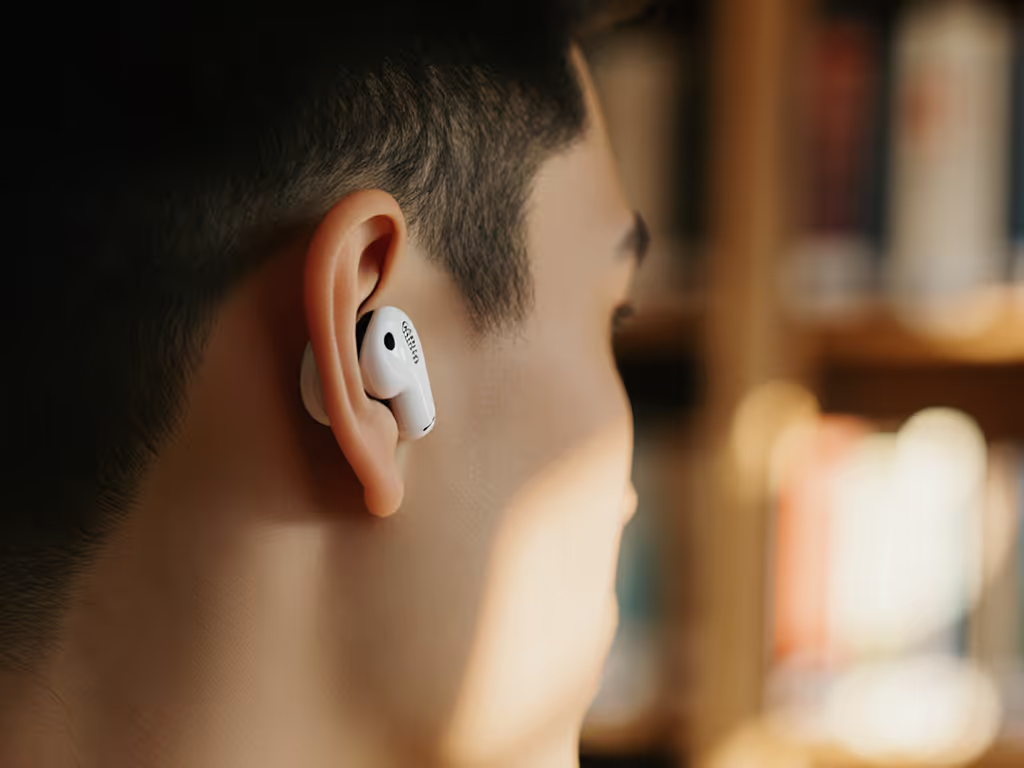
What Are Language Learning Earbuds, and Why Does Comfort Matter?
Language learning earbuds are wearable audio devices designed to support accent training, pronunciation feedback, and real-time language practice through app integration and voice recording capabilities. But here's what most reviews miss: without proper fit and pressure management, even the smartest app becomes a barrier to learning.
After years of mapping ear canal angles with silicone casts, I've seen the same pattern: learners abandon pronunciation tools because their earbuds hurt after 20 minutes. The physics is straightforward: a poor seal forces you to crank volume, your ear aches from shell pressure, and suddenly you're reaching for your phone's speaker instead. Comfort isn't luxury; it's the precondition for longer listening. For model-by-model long-wear ergonomics and tip-fit advice, see our comfort fit earbuds comparison. When your ears are comfortable, you retain more, practice longer, and actually build the muscle memory that language learning demands.
FAQ: Finding Your Perfect Fit
Why Does Fit Matter More Than Features for Language Learning?
Pronunciation feedback only works if you can hear it clearly, and you can only hear it clearly with a stable seal. A secure fit delivers three critical advantages: consistent bass response (essential for hearing tonal languages), uninterrupted playback for accent training audio, and the psychological comfort that lets you focus on the material, not the device.
Your ear canal isn't symmetrical. One side may seal perfectly with a standard small tip while the other barely seats. Learners caught in this bind end up rotating buds constantly, breaking the seal and missing subtle pronunciation cues. The solution isn't a thinner device; it's tip geometry variety and nozzle angle alignment to match your individual canal path.
What Tip Options Should I Look For?
A fit-first earbud ecosystem includes at least three choices: shallow silicone (for short, wide canals), deep silicone (for longer canals with forward angle), and hybrid or foam options for sensitive skin or users seeking a lighter insertion feel. Each material and depth changes how pressure distributes across your tragus and anti-tragus, the cartilage landmarks that bear the load during extended sessions.
If you've experienced ear soreness after language app sessions, you likely encountered a tip geometry mismatch. Deep foam tips, for example, exert outward pressure at the canal entrance when worn too far in; shallow silicone tips may rotate during neck movement. The right match is one where insertion depth feels natural (neither shallow nor deep), and where the seal holds stable through normal head movement and jaw motion (which occurs constantly during speech practice).
How Do I Know If My Seal Is Working?
A vocal clarity test reveals your seal quality. Record your voice using your earbuds' integrated voice recording feature. If your own voice sounds muffled, occlusion-heavy, or thin in the bass, your seal is incomplete. Adjust tip size or nozzle angle slightly and record again. The moment the bass feels balanced and your voice sounds natural (not boomy, not thin), you've found your fit point. For the science behind comfort and safe practice sessions, see how earbud fit impacts hearing health.
For accent training audio specifically, an unstable seal creates another problem: you hear the reference accent at inconsistent levels. Your brain adapts poorly to variable input, and pronunciation feedback becomes less reliable. A consistent seal ensures a consistent acoustic environment for learning.
What About Pressure Build-Up During Long Sessions?
Occlusion (that tight, plugged-ear sensation) builds over time if ventilation is poor or if your tip sits too deep and traps air. Many language learners report dull aches or mild dizziness after 60-90 minutes of immersion sessions. This isn't inevitable.
Look for earbuds with acoustic venting (small air pathways in the shell or nozzle) that allow air exchange without degrading seal. Open-earpiece designs, common in translation and listening devices, reduce occlusion entirely, useful if you're switching between language app sessions and ambient awareness. For closed-fit earbuds, a shallow nozzle angle (avoiding deep insertion) and soft silicone material help distribute pressure evenly across your canal walls rather than concentrating force at one point.
Respect your ears. If you feel pressure after 30 minutes, your fit is teaching you something: either the insertion depth, tip size, or material isn't working for your anatomy. Switching to a shallower tip or softer material often resolves this within one session.
Key Features for Language Learners
Real-Time Translation and Accent Training: How Do They Work Together?
Real-time translation in modern language earbuds uses AI translation engines powered by natural language processing to capture speech, interpret context and tone, and output translations across 100+ language pairs. The latency (typically 1-3 seconds) makes real-time conversation possible. However, this technology serves a different purpose than accent training audio.
For language learning specifically, you need voice recording for language practice and pronunciation feedback, not simultaneous translation. These require:
- Built-in microphones that capture your own voice clearly (demanding a stable seal and unbroken audio path)
- App integration that logs recordings for playback and comparison against native-speaker references
- Minimal processing lag so you hear your voice naturally without strange delays
Translation earbuds with robust voice capture, like models featuring full-color LCD screens for language selection, can support both translation mode and practice recording mode. The key is finding one where the microphone design doesn't degrade when your seal changes.
Why Does Language App Integration Matter?
Language app integration transforms earbuds from passive listeners into active learning tools. Apps that sync with your earbuds enable:
- Voice-activated practice modes (speak a phrase, hear it played back through the app for comparison)
- Real-time pronunciation scoring based on microphone input
- Offline access to pre-downloaded accent training audio for commutes or travel
- Personalized feedback loops (the app learns which sounds you struggle with)
When testing earbuds for language learning, verify that the app has true two-way functionality, not just translation, but also your voice being captured and processed for learning. Some translation earbuds, like those mentioned in professional guides, include companion apps specifically for studying, making them dual-purpose for commuters who translate in the morning and practice in the evening. For a feature-by-feature look at software controls and EQ, read our earbud companion app comparison.
What About Noise Cancellation for Focus?
Active noise cancellation (ANC) helps language learners concentrate by reducing distracting ambient sound. However, ANC quality is entirely dependent on seal stability. A loose seal causes ANC to fail partially or completely, and you'll hear inconsistent rumble from traffic or wind. This breaks concentration and makes it harder to hear subtle accent differences in your training audio.
Choose earbuds where seal stability is built-in through ergonomic design (not reliant on tip size alone). Models designed with comfort-first geometry tend to maintain seal consistency even during head movement, ensuring ANC remains reliable through an entire language lesson.
Comfort & Clarity in Action
How Do I Test Comfort Before Committing?
If possible, test earbuds in-store for at least 10-15 minutes of continuous wear. Perform a simple test: tilt your head side to side, touch your ear, and move your jaw as if speaking. Your earbuds should not rotate or shift. Speak a few sentences aloud and listen to how your voice sounds through playback, this reveals seal quality without any app setup.
If in-store testing isn't available, prioritize brands offering clear tip size guidance tied to ear canal anatomy (not just S/M/L), detailed return policies, and customer feedback specifically about long-session comfort. Avoid generic marketing claims; look for testimonials mentioning actual time-worn (e.g., "comfortable for 4-hour language sessions").
What Should I Do If One Ear Seals Perfectly and the Other Doesn't?
Asymmetric ears are common and often overlooked in earbud design. If you find perfect seal on one side but constant fiddling on the other, you have three options:
- Tip size asymmetry: Try a different tip size on the non-sealing side only (e.g., medium on the left, small on the right). Many earbuds now ship with multiple sizes to support this.
- Nozzle angle mismatch: Some earbuds with adjustable or angled nozzles allow rotation to match your canal orientation. Rotate the earbud slightly and test again.
- Insertion depth variation: Insert the sealing side to your natural stopping point, then consciously insert the other side to the same depth (not by feel, but by mirror check). Comfort often comes from symmetry, even if asymmetry feels more secure initially.
Respect your ears enough to troubleshoot patiently. One small adjustment often unlocks both sides.
Actionable Next Steps
If you're shopping for language learning earbuds, prioritize these moves:
-
Assess your ear profile. Before researching specific models, understand your own anatomy: Do your canals angle forward or backward? Are they wider or narrower than average? Do you experience pressure easily? Honest self-assessment helps you avoid mismatches.
-
Prioritize seal stability over specs. Read reviews specifically mentioning fit consistency during movement and long-session comfort, not just battery life or app features. Look for evidence that the earbud maintains seal through realistic language-learning scenarios (sitting, walking, typing, speaking).
-
Test the app integration before purchase. Many earbuds tout language features; fewer actually integrate smoothly with mainstream apps like Duolingo, Babbel, or Rosetta Stone. Ask: Does the earbud's app allow voice recording? Can it sync with your learning platform? Is latency low enough for real-time feedback? When you're ready to compare models tailored to learners, start with our Best Language Learning Earbuds guide.
-
Request a fit kit or sample tips. If the brand offers multiple tip options, request samples that match your estimated size before full purchase. A 30-second fit test can save weeks of discomfort and returns.
-
Plan for a 2-3 week adjustment window. Even with perfect fit, your ears adapt gradually to consistent earbud wear. Give yourself time before deciding to return. Small pressure points often dissolve as your cartilage adjusts and you refine insertion technique.
Language learning demands focus, repetition, and sustained engagement. When your earbuds feel invisible (held stable, seal intact, audio clear), your brain stays on the language, not the device. That's when real learning accelerates. Build your choice from the ground up: comfort first, features second. Your ears, and your fluency, will thank you.
Related Articles